
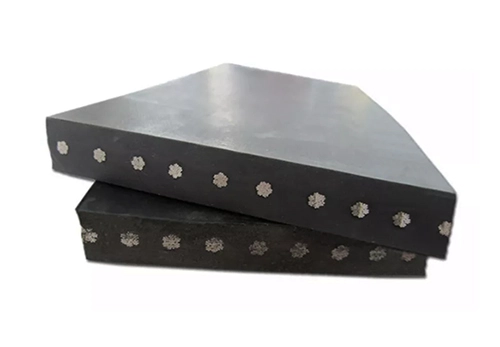
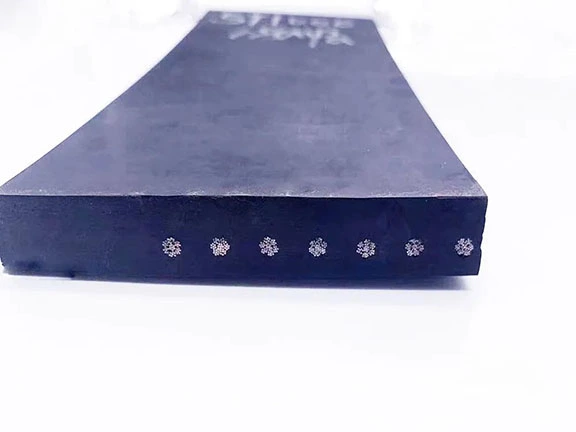

Features of Anti-tear Steel Cord Conveyor Belt
- High tear resistance and low elongation
- Strong adhesion between rubber and steel cord
- Flame retardant, oil resistant, and abrasion resistant
- Suitable for handling hard and sharp materials
- Good impact resistance and fatigue resistance
- Superior grooving formation properties
Specification of Anti-tear Steel Cord Conveyor Belt
| Specification | Weight | Pitch of Weft | Thickness | Diameter | Breaking Strength | Elongation at Break |
| Kg/㎡ | mm | mm | mm | N | % | |
| KF-50 | 0.21 | 10 | 1.8 | 0.65 | 560 | >2 |
| KF-100 | 0.39 | 10 | 2.2 | 1 | 1050 | >2 |
| KF-125 | 0.63 | 8 | 2.4 | 1.18 | 1000 | >5 |
| KF-150 | 0.73 | 8 | 2.6 | 1.38 | 1360 | >5 |
| KF-200 | 0.92 | 6 | 2.6 | 1.38 | 1360 | >5 |
| KF-250 | 1.2 | 10 | 3.1 | 1.9 | 2530 | >5 |
| KF-300 | 1.32 | 8 | 3.1 | 1.9 | 2530 | >5 |
| KF-400 | 1.6 | 6 | 3.1 | 1.9 | 2530 | >5 |
| KF-500 | 2.22 | 5.6 | 3.3 | 2.02 | 2900 | >5 |
Applications of Anti-tear Steel Cord Conveyor Belt
Anti-tear steel cord conveyor belts are used in:
Mining: Transporting heavy minerals and ores, particularly in underground operations.
Construction: Moving bulk materials like sand, gravel, and debris from demolition sites.
Steel and Metal Industry: Handling hot, sharp slag and scrap metal.
Cement Industry: Conveying clinker and raw materials.
Ports and Terminals: Efficiently loading and unloading bulk cargo.
Power Plants: Transporting coal and ash.
Agriculture: Moving grains and fertilizers.
Recycling and Waste Management: Handling solid waste and recyclable materials.
Chemical Industry: Conveying corrosive materials.
Wood and Pulp Industry: Transporting logs, timber, and wood chips.